

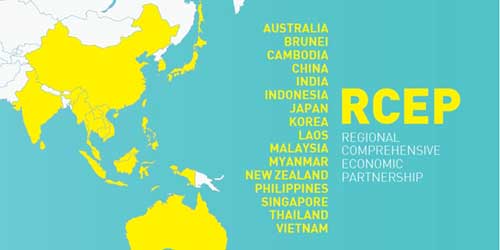
Ten ASEAN member countries and six partner countries that have signed free trade agreements (FTAs) with ASEAN, including India, Australia, China, Japan, New Zealand, and the Republic of Korea (RoK), joined the 12th round of negotiations on the Regional Comprehensive Economic Partnership (RCEP) with discussions focusing on cutting tariffs in an effort to achieve the RCEP agreement later this year.
RCEP, counterbalance to TPP?
RCEP is a trade deal covering a wide range of fields including goods, services, investment, economic and technical cooperation, competition, and intellectual property rights. With 16 member countries, this will be the biggest FTA in terms of population, involving 3.35 billion people or over 50 percent of the world’s population, and 27 percent of global gross domestic product. Among RCEP members, China is an important factor to promoting regional trade.
Seven countries currently negotiating the RCEP, including Australia, Japan, Malaysia, New Zealand, Singapore, Vietnam, and Brunei, had been Trans-Pacific Partnership (TPP) negotiators. The TPP was signed by 12 member countries this February, putting RCEP negotiators under pressure to achieve the agreement as soon as possible.
The RCEP will eliminate tariffs for 65 percent of commercial goods (8,000-9,000 kinds of goods) as soon as it takes effect and an additional 20 percent within the next 10 years. Member countries will continue negotiations on specific tariffs to be applied to the remaining 15 percent of commercial goods, including sensitive products of each country, in the future.
Experts on international economics think the RCEP should promote trade liberalization at a higher level compared with ASEAN’s FTAs, otherwise it will face difficulties in competing with the TPP.
India, a knot
At the 12th round of RCEP negotiations, some member countries said India’s defensive approach was the main reason for the standstill in negotiations. Australia, China, Japan, New Zealand, and the RoK have urged India to make deeper tariff cuts for key products or withdraw from RCEP negotiations. They accused India of approaching important negotiating issues in a halfway manner.
Due to the FTA it signed with ASEAN, India has agreed to eliminate tariffs for 80 percent of goods from ASEAN countries to access this market. However, it agreed to eliminate tariffs for just 65 percent of goods from Japan and the RoK, and 42.5 percent of goods from Australia, China, and New Zealand. India did not introduce any tariff cuts for steel products of China, Australia, and New Zealand.
Australia, Japan, and the RoK continue to request India to further open its economy in the field of agriculture and services through deeper tariff cuts as these are key sectors of the Indian economy.
RCEP negotiations commenced in May 2013, involving 10 ASEAN economies and six trading partners: China, India, Japan, Australia, New Zealand, and the RoK. RCEP is considered as a strong step forward following the formation of the ASEAN Community on December 31, 2015
Source : ven
Keyword : 12th round, of RCEP negotiations, cutting tariffs, to achieve agreement.