
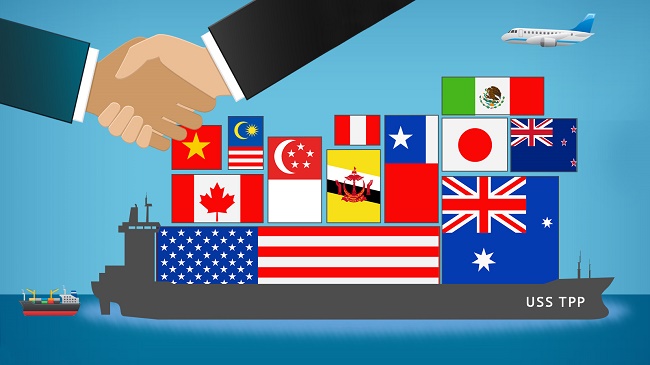
The Trans-Pacific Partnership (TPP) was signed on February 4, 2016 opening up opportunities for businesses. The TPP including 12 member countries which are a home of 800 million people, accounting for 40 percent of the world gross domestic product (GDP) and 30 percent of total trade promises to promote economic growth and resolve challenges in international trade.
Increasing US$23.5 billion in GDP by 2020
The TPP outlines high standards in terms of trade, technical barriers, intellectual property and labor force in addition to tariff reductions. The TPP will offer opportunities as well as pose difficulties for member countries.
The TPP will help Vietnam’s GDP increase by US$23.5 billion by 2020 and US$33.5 billion by 2025, while exports will increase by US$68 billion by 2025.
Garment and textile exports will increase thanks to the TPP. According to calculations, every US$1 billion in garment and textile exports would create around 250,000 kinds of jobs. In addition, Vietnam has full conditions to attract investment in weaving, dyeing and manufacturing of garment and textile materials. Similar to garments and textiles, exports of footwear, agro-forestry products and seafood will also increase.
Vietnam will be provided opportunities to participate in new supply chains due to the presence of large markets such as the US and Japan.
Some corporations and groups around the world, especially the US companies are considering investment in Vietnam with the goal of turning the country into one of important points in their production chains. Meanwhile, Vietnamese businesses will easily enter the public procurement markets of member countries such as the US, Japan and Canada.
Fiercer competition
The TPP’s general principle is to cut import duties to zero percent against all tariff lines.
Large markets such as the US, Japan and Canada reducing import duties to zero percent will create a breakthrough for Vietnamese goods. In addition to footwear, agro-forestry products and seafood, Vietnamese garment and textile exports to the US will significantly increase thanks to the TPP as the current tax rate for those items in the US is 17.5 percent.
However competitive pressure will be huge after import duties return to zero percent, especially for pork and chicken because Vietnam’s competitiveness in these products remains low. Some other products such as dairy products, soybeans, maize and animal feed will also face difficulties.
The TPP member countries have advantages in terms of industrial products like paper, steel and cars that will pose difficulties for Vietnamese production. However competitive pressure will not be huge due to Vietnamese products generally targeting medium quality segments, while better quality products are likely to be targeted by the other TPP member countries.
Declining import duties to zero percent will cause a reduction in tariff revenues and will not cause any pressure on products that the TPP member countries have manufactured such as confectionary, detergents, jewelry, air conditioners, interior products, wines, tobaccos and high capacity motorcycles.
Strictly following regulations
Vietnamese businesses need to carefully study information in the TPP related to their sectors. For example, Vietnamese garment and textile businesses must meet the yarn forward rule of origin to enjoy tax incentives. However the TPP also has a short supply list in which businesses are allowed to import some kinds of fabrics and yarns from third parties to manufacture garment and textile products.
The TPP also mentions government procurement based on international bidding to select investors from member countries. The TPP does not cover purchases by local governments and these provisions do not apply to national defense procurement.
The TPP’s obligations are applied to state-owned enterprises in which the state owns more than 50 percent of chartered capital. Vietnam has accepted the need to ensure fair competition, except for companies operating in national defense.
“Businesses and the whole economy need to make greater efforts to realize opportunities, renew the growth model, restructure the agricultural sector, reorganize production and promote the application of science and technology. An increasingly open agricultural sector will be implemented following a suitable schedule to support restructuring,” Tran Quoc Khanh recommended.
Deputy Minister of Industry and Trade Tran Quoc Khanh said that TPP negotiations were implemented to ensure the highest benefits for the country, and create new opportunities for socioeconomic development, especially in exports and foreign investment attraction.
Source : ven
Keyword : TPP, realizes, opportunities.