

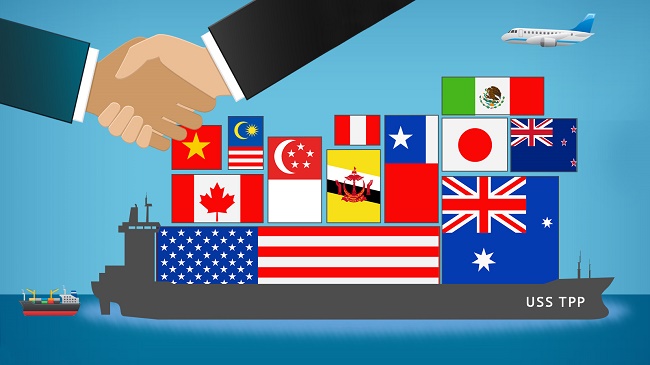
Vietnam is often cited as the biggest winner in the Trans-Pacific Partnership trade agreement led by the U.S. and Japan. There is little doubt about the trade benefits of the TPP for Vietnam, but the financial and macroeconomic impacts on the country have not been examined in the same way.
After seven years of painfully detailed negotiations, the 12 Pacific Rim countries signed the agreement in Auckland, New Zealand, in February. The TPP is seen as a high-quality trade agreement, with innovative chapters covering the digital economy and labor standards, as well as a code of conduct for state-owned enterprises.
Many economic studies indicate that Vietnam will likely benefit from higher exports, larger foreign direct investment inflows and a rise in economic growth. Both import tariffs and nontariff barriers will fall in the country's important export destinations, especially the U.S. and Japan.
In particular, Vietnam's exports of textiles, garments and consumer electronics are forecast to increase substantially. The World Bank has said the agreement will add about 10% to Vietnam's gross domestic product by 2030. Total exports are expected to increase by almost 30% by 2030.
Apart from these trade gains, Vietnam will also see an improvement in its financial standing, including an increase in its foreign reserves, which have often looked precarious and in 2015 were worth less than the value of three months' imports, the minimum recommended by the International Monetary Fund for most economies.
With an increase in exports, Vietnam will start to see a steadier flow of foreign reserves into its coffers and a potentially larger current-account surplus. Net exports of goods and services have grown over the last few years, but the current-account surplus was only $1.3 billion in 2015 and a deficit is forecast this year. As recently as 2010, the current-account deficit was $4.3 billion.
With an improvement in the current account, investors will gain more confidence in the currency. Vietnam has reduced its levels of currency management over the years, but nevertheless devalued the dong three times last year. One of the benefits of the TPP may be a more stable currency.
Historically, inflation has been a problem for Vietnam, although it has fallen to manageable levels in recent years. Part of the problem has been that in the face of slower growth, the government has often resorted to expanding domestic credit to increase economic activity. For example, credit growth reached 27% on an annual basis in 2010, leading to almost 19% inflation in the following year.
NEW TOOLS To combat inflation, credit growth was reduced to 12.5% in 2013, leading to much lower inflation in 2014 and 2015. But history has shown that the government has few qualms about employing credit expansion as a tool to boost the economy, despite the dangerous side effect of double-digit inflation. The TPP opens up a new and sustainable channel to generate growth for Vietnam and should reduce the need for the government to rely excessively on domestic credit.
An improvement in trade and the economy will create more employment opportunities. About a quarter of Vietnam's population of 91 million people is between the ages of 15 and 34. Each year, more than 1 million people join the workforce. However, the International Labour Office, the permanent secretariat of the International Labour Organization, has calculated that almost 40% of the workforce between the ages of 15 and 29 is in vulnerable employment, such as unpaid work for family members.
Source : http://asia.nikkei.com/
Keyword : K.C. Fung, The TPP means more than, trade for Vietnam.