
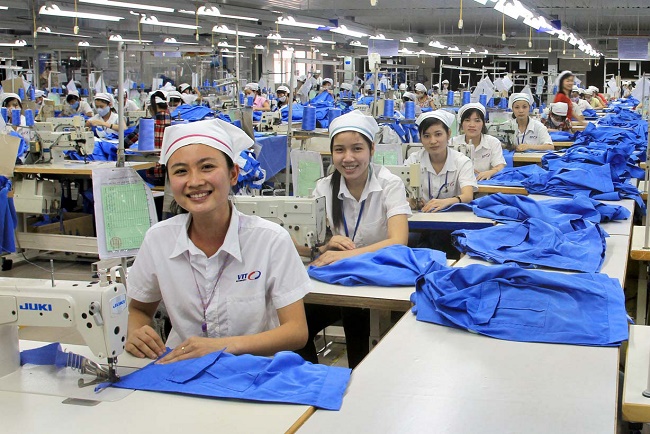
After the Trans-Pacific Partnership (TPP) takes effect, taxes that Vietnamese textile, garment exporters to the US pay will decrease 64 percent, helping save US$1-1.1 billion annually.
According to Vietnam National Textile and Garment Group (Vinatex) General Director Le Tien Truong, Vietnamese textile and garment exports to the US are subject to a tax rate of 17.5 percent, but when the TPP takes effect, 73 percent of tax lines will be reduced to zero percent, allowing exporters to save US$1-1.1 billion per year.
Domestic textile and garment businesses also expect to benefit from new export markets such as Canada, Australia, and Peru. In the first year of the effective TPP, 42 percent of taxes applied to exports to Canada will be reduced to zero, and this will rise to 57.1 percent in the fourth year. Vietnamese textiles and garments currently hold a market share of just about two percent in Canada, so there is room for increasing exports to this market.
However, the yarn-forward rule of origin remains a big hindrance to textile and garment business efforts to benefit from tariff preferences. Many economists share the opinion that domestic businesses remain reluctant to invest in material production because they think their products cannot compete with imports from China on price.
However, it is necessary to maintain the local content of products at a certain rate to ensure competitiveness. Since 2005 Vinatex has developed many material production investment projects which have helped increase the localization rate from 20 percent to 50 percent in 2015. The group expected it could source about 60 percent of materials from domestic suppliers after the TPP takes effect.
Due to the insufficiency of supplies from TPP countries, the agreement allows businesses to buy some kinds of materials from non-TPP countries and enjoy tax preferences when doing this. Of the total 194 material lines specified in the TPP, eight lines will be subject to these rules of origin for five years and the remaining 186 lines will be subject to the rules forever. Vietnamese products to be subject to cut and sew rules of origin include knapsacks, handbags, children’s clothing made of polyester fabrics, and corsets. To produce trousers from cotton fabrics, businesses will be allowed to buy fabrics from both TPP and non-TPP countries.
Source: http://ven.vn/vi-VN
Keyword : TPP, to save money, for Vietnamese textile, garment exporters.