
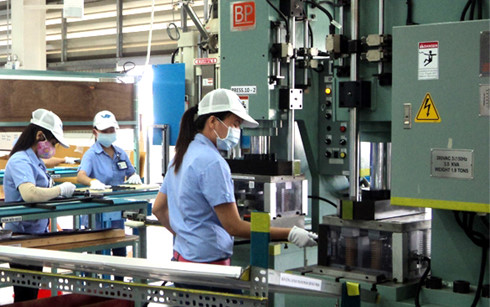
The Vietnam government is intent on fostering the development of a competitive supply chain in the manufacturing sector— a prerequisite to capitalizing on the benefits of trade agreements, say experts.
Specifically, experts at a recent business forum in Hanoi spoke about the Vietnam-EU free trade agreement that is expected to boost exports when it comes into force in 2018, but only if strong domestic supporting industries can be put in place.
The trade pact provides that businesses will only benefit from tariff preferences if they can prove that they are the ‘originator’ of the products they export to EU member countries.
One way the businesses can qualify to be considered the originator is by incorporating into their final product only materials that are produced locally in Vietnam, they said, adding that this is the primary impetus for development of the domestic supply chain.
A second way the businesses will be able to meet the strict requirements is by incorporating materials that have undergone sufficient working or processing within Vietnam.
This latter method is outlined in detail in Annex II of the trade agreement. They experts say it would be extremely difficult for local businesses to comply with these requirements unless there are considerable advances made in the domestic supply chain.
A third alternative is for local companies to purchase their raw materials and other inputs from a country that has an existing free trade agreement with the EU. Within Asia this means acquiring the necessary raw inputs from the Republic of Korea as it is the only Asian country that currently has the requisite relationship.
Local businesses seeking to export to the EU from Vietnam must meet comply with at least one of the requirements to obtain a certificate of origin as outlined by the trade accord and Vietnamese legislation.
In addition to completing applicable forms, it may be necessary for these businesses to produce direct evidence supporting specifically who manufactured the materials incorporated into the final product subject to penalties of perjury and criminal prosecution for submitting intentionally false or information made with wilful disregard for the law.
There is an exception (or a de minimis rule) for certain small exporters for which the total consignment will not exceed EUR 6000 (US$6,400). These local businesses will need only complete an ‘origin declaration,’ which is an alternative streamlined procedure.
A few of the globe’s largest manufacturers are already producing in Vietnam, but their ratios of locally procured parts and materials are low. Samsung Electronics' ratio stood at about 10% as of last year, while Toyota Motor's was 19-37%, depending on the car model.
Currently, only a relatively few local suppliers can meet these transnational companies’ high quality standards.
The Vietnam Chamber of Commerce and Industry has estimated that collectively local businesses account for only about 20% of the supply chain in the country.
But to succeed with getting the manufacturing supply chain on track and operating optimally, say the experts, the Vietnam government authorities, local businesses and academia will need to all get on the same page.
Source: VOV
Key words: strengthening, supply chain, growth, manufacturing