

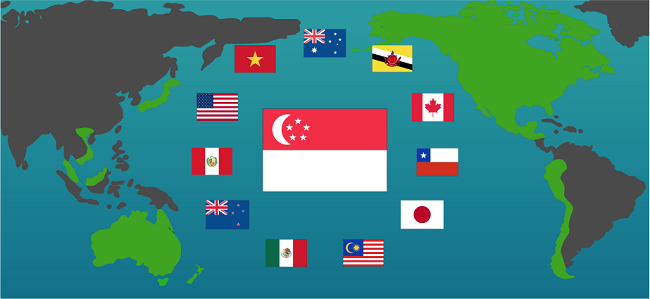
The Trans Pacific Partnership Agreement (TPP) was signed by twelve countries in February 2016. Despite the extensive media coverage of the TPP, relatively few detailed country-level studies have emerged on the impact of TPP. The objective of the seminar is to discuss and examine in greater detail the impact of the TPP on three Southeast Asian countries. In the seminar, three distinguished country economists from the region examined the potential economic impact of the TPP on three Southeast Asian countries that are participating in the TPP, namely, Malaysia, Singapore and Vietnam.
Malaysia
Tham Siew Yean, a Senior Fellow at ISEAS – Yusof Ishak Institute, assessed Malaysia’s export opportunities in the TPP. The research, conducted jointly with Dr Andrew Kam from Universiti Kebangsaan Malaysia, used trade indicators (based on differences in exports shares) to compare Malaysia with Vietnam in two sectors - textile and clothing and ICT. Two key findings emerged from their study. First, in terms of market access for these two sectors, accessing the benefits of the agreement will require Malaysian firms to compete against Vietnam in textile and clothing scheduled for liberalization in the US market. Second, Malaysia still has an advantage over Vietnam in electronics in ICT but the latter is rapidly catching up.
Singapore
The case of Singapore was examined by Associate Professor Shandre Thangavelu who is currently the Regional Director (Southeast Asia) at the Centre for International Economic Studies, Institute of International Trade, University of Adelaide, Australia. Dr Thangavelu argued that many of the issues related to TPP overlap with the challenges arising from the servicification of the Singapore Economy. These include unhooking from manufacturing sector, human capital development, innovation and entrepreneurship, connectivity and linkages in services, the complementarity in the development of services and GVC. E-commerce is also an important feature in the TPP with stronger impact for Singapore. The liberalization of services is important for Singapore to reap the benefits of TPP.
Vietnam
Dr Vu Thanh Tu Anh, director of research at the Fulbright Economics Teaching Program in Ho Chi Minh City and a senior research fellow at the Harvard Kennedy School, discussed the impact of the TPP on Vietnam. In his presentation, Dr Tu Anh argued that the benefits of TPP for the textile and clothing industry will be lower than current quantitative estimates due to the sector’s heavy dependence on imported inputs, especially from China. The ability of Vietnam’s textile and garment industry to take advantage of TPP will depend on its ability to develop upstream industries and upgrade the supply chain as well as its capability to overcome the technical barriers of important markets such as the US, Japan and Canada.
Close to 50 participants attended the 3-hour morning seminar.
Source: https://www.iseas.edu.sg
Key words : The Impact of TPP, on Malaysia, Singapore, and Vietnam.