
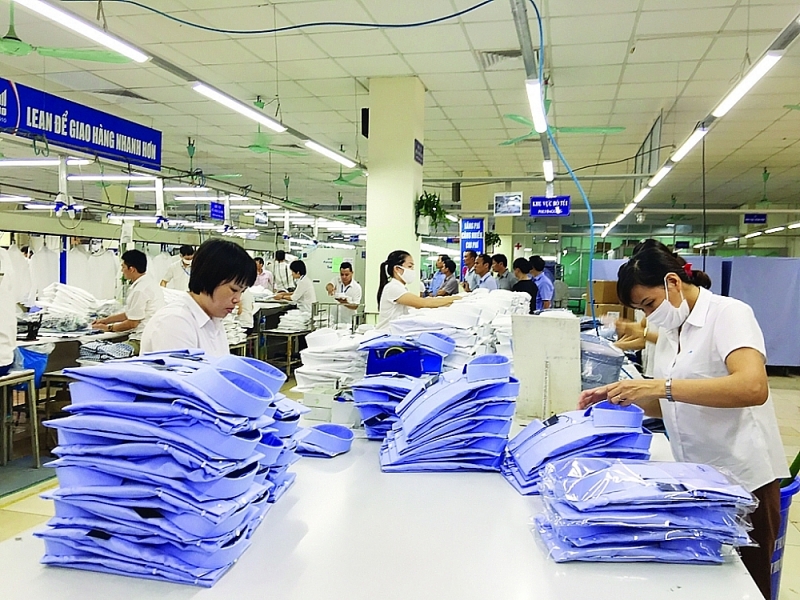
In 2016, textile export turnover was only US$28.1 billion, but by 2019 it reached US$38.9 billion, with average growth of 9.55%. In particular, the trade surplus has outstanding growth when it reached US$11.1 billion in 2016 and US$16.9 billion in 2019.
According to the Department of Industry (the MoIT), in 2020, with the decrease in consumption demand of the US and Europe markets in the context of implementing pandemic prevention measures, it had a huge impact on the total turnover. Vietnam's textile and garment exports to the US and Europe account for about 45% and 18% of the garment export turnover, respectively.
Export turnover of the textile industry in 2020 is estimated at US$35.27 billion, down 9.29% compared to 2019, in the context of a 25% decrease in world textile demand.
However, in general, Vietnam's textile industry has made great progress, making good use of the signed Free Trade Agreements (FTA) such as FTA Vietnam - Korea, Vietnam - EAEU, Comprehensive and Progressive Agreement for Trans-Pacific Partnership (CPTPP), and the EU-Vietnam FTA (EVFTA).
Specifically, in 2016, textile export turnover was only US$28.1 billion, but by 2019 it reached US$38.9 billion, an average growth rate of 9.55%. In particular, the trade surplus has outstanding growth when it reached US$11.1 billion in 2016 and US$16.9 billion in 2019.
Vietnam's textile and garment export turnover from 2016 ranked fourth in the world, after China, Bangladesh, and India, by 2019, it surpassed India, ranking third in the world. Vietnam Textile and Garment continues to maintain this position in 2020 despite being affected by the Covid-19 pandemic.
Mr. Le Tien Truong, Chairman of the Board of Directors of Vietnam National Textile and Garment Group (Vinatex), assessed that 2021 will still be full of difficulties and uncertainties with the textile industry.
With the trend of price reduction, simple goods will replace fashion, leading to available production capacity becoming redundant and new production capacity will arise. However, in 2021, the textile and garment industry still sets the highest export plan at US$39 billion.
Textile and garment enterprises suggest that the Government should continue to maintain macroeconomic stability to create sustainable development for domestic enterprises, the bank sector needs to reduce long-term loan interest rates and have guidelines more specifically about FTAs.
In addition, the Government also needs to continue to direct the reduction of non-production costs, especially logistics costs through the planning of the national logistics network, and other tariff costs.
Source: VCN
Key words: textile, export turnover, EVFTA, VKFTA, sustainable development, domestic enterprises, textile and garment industry