
Vietnam and Japan are entering new horizons for further bilateral investment ties, with the former becoming a key market for the latter’s businesses to shore up their supply chains overseas.
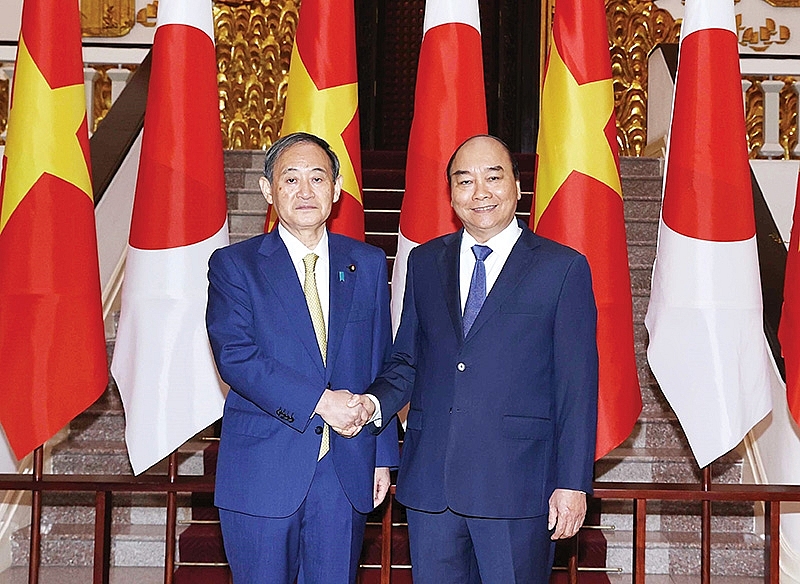
Yoshida Tomoyuki, spokesperson for the Japanese Ministry of Foreign Affairs, told VIR that the visit by Japanese Prime Minister Suga Yoshihide to Vietnam last week “has paved the way for a new surge in Japanese investment in Vietnam in the time to come.”
“We are expecting bigger Japanese investment inflows into Vietnam, which is already a major investment destination for Japanese businesses in ASEAN. They are using Vietnam as a market for diversifying their supply chains and logistics activities,” Tomoyuki said. “They see that it is not good for them to depend on a single market like China, and Vietnam is quite an attractive market for them to increase investment.”
Under its new policy, Japan is now making efforts to diversify its supply chains and decrease reliance on China by bringing production home or moving it to Southeast Asia. Vietnam is a popular choice for Japanese businesses – half of the 30 Japanese firms that used a ¥23.5 billion ($222.8 million) government programme to diversify supply chains in Southeast Asia have targeted Vietnam, which has aggressively courted such investment.
Last week after talks between PM Yoshihide and his Vietnamese counterpart Nguyen Xuan Phuc, Japanese and Vietnamese firms and agencies announced 12 agreements and MoUs worth a combined $3.7 billion, covering areas ranging from digital economy and the environment to energy and infrastructure.
The biggest among them is a $1.9 billion 1,500MW gas-fired power project in the northeastern province of Quang Ninh, with participation from Tokyo Gas Company and Marubeni Corporation.
A source from Quang Ninh Investment Promotion Centre told VIR that, initially, state-owned Electricity of Vietnam (EVN) and domestic group COLAVI JSC asked the province to add the venture to its gas-fired power development plan. Quang Ninh agreed with the proposal on the condition that the Ministry of Industry and Trade (MoIT) also agreed to put the project into the country’s seventh National Power Development Plan.
“After getting the green light from Quang Ninh and the MoIT, EVN and COLAVI sought foreign partners, and Tokyo and Marubeni were selected,” the source said. “The project is located in Cam Thinh quarter of the province’s Cam Pha city, and the province expects that it will be implemented as soon as possible so that it can contribute to the provincial budget and employment.”
Furthermore, Marubeni will also invest in the $1.3-billion O Mon 2 power plant in the Mekong Delta city of Can Tho. This scheme is among four similar plants at the O Mon power centre, with total capacity of 750MW and total investment capital estimated at VND26.3 trillion ($1.14 billion). The project is expected to be fully operating by 2026.
Meanwhile, AEON Group announced last week it will develop a $250-million mall in Ho Chi Minh City. It previously said it would invest $2 billion expanding its presence across the country, anticipating 20 shopping malls to be opened by late 2025. At present, AEON has poured over $700 million in developing five supermarkets in Vietnam.
“I have reaffirmed with PM Yoshihide that Vietnam has been in good preparation in land, human resources, investment climate, and policies for welcoming more Japanese investment, especially a series of major projects that both sides have just agreed to boost,” PM Phuc told the media after the talks.
The Japanese leader said the two nations will bolster cooperation to mitigate the impact of the ongoing pandemic, and announced a resumption of air travel links.
“We agreed on restarting ‘business track’ travel as well as passenger flights between the two countries,” he said.
The specific time for officially resuming commercial flights between will be fixed by authorised agencies of both nations, which the Japanese side expects will take place soon.
“The Japanese government and enterprises also continue to support Vietnam’s economic development with a flagship infrastructure project being the urban railway in Ho Chi Minh City,” said PM Yoshihide.
Japan is one of Vietnam’s most important economic partners, the largest official development assistance donor, second-biggest investor, third-largest tourist source, and fourth-largest trade partner.
According to the Vietnamese Ministry of Planning and Investment, as of September 20, Japan had nearly 4,600 valid investment projects in Vietnam registered at nearly $59.9 billion.
Source: VIR
Key words: Japanese businesses, supply chains, Japan