

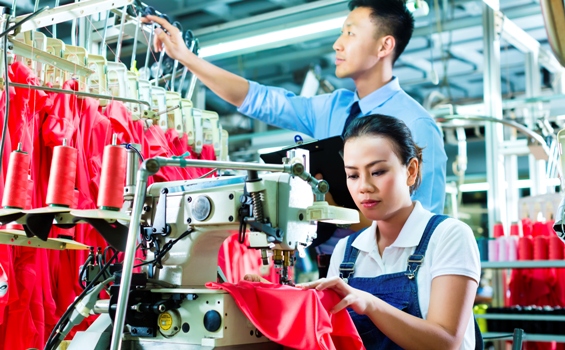
Vietnam, as almost a “sole supplier of textile products” among Trans-Pacific Partnership (TPP) member countries, is banking on the TPP deal to expand its textile market share, according to VITAS – the Vietnam Textile and Garment Association.
Moreover, a spokesperson from the association says: “Many Hong Kong, South Korean and Australian firms are developing and planning major textiles FDI [foreign direct investment] in Vietnam to produce yarn and fabric, the supporting textiles industry for apparel production.”
Investors are eyeing Vietnam because it is an important supplier of textiles to large consumer markets of TPP countries, such as South Korea and the US. “In 2015, export turnover of Vietnam’s garment market to TPP member countries reached US$14.7bn, up 10% compared to 2014, accounting for 66.55% of total export turnover of Vietnam items and contributing 89.17%...of the whole industry export turnover increase,” says a VITAS report. Furthermore, in 2016, “garment exports from Vietnam to the TPP markets would rebound strongly, with growth expected to be 13% compared to 2015.”
Its analysis stressed that 2013 was a turning point for the sector as it was “the first year Vietnam’s textile and apparel export turnover exceeded US$20bn.” In 2014, the industry generated US$24.45bn in exports, up nearly 16% compared to 2013. “That shows the result of the outstanding efforts of the industry in the past 10 years,” says the report. As per estimates from VITAS in 2015, the garment export turnover in Vietnam reached US$27.02bn, up 9.43 % over the same period in 2014.
One repercussion of recently struck free trade agreements such as the TPP and Vietnam-EU trade deal is a sudden increase of mergers and acquisitions in Vietnam’s textile and garment industry. While large and medium-sized companies have confidence in their ability to compete in resulting open markets, smaller Vietnamese enterprises could struggle to fulfil larger orders due to a lack of capital.
As a result, according to a VITAS spokesperson, there has been a trend towards smaller businesses merging to create larger, stronger companies, or even selling their business and quitting the sector. “Yes, there was some small garment companies [that] closed down recently because they are too small and could not meet up with the changing and rising competition,” says the VITAS spokesperson.
Meanwhile, Vietnam’s weak backwards linkages have once again been exposed by increases in clothing and apparel input imports. In 2015, “Vietnam imported fabrics estimated at 10.1 billion, up 8.2 % compared to the same period of 2014,” says the report. Imports of fibre and fibre raw materials to Vietnam in 2015 was estimated at 790,000 tonnes, worth US$1.5bn, up 6.8% in volume and 2.7% in value over the same period of 2014,” says the report.
And in 2015, cotton imports into Vietnam imported increased 34.3% in volume to 1.01 million tonnes, worth US$1.6bn and 12.4% in value over the same period in 2014.
Despite this, Vietnam is slowly growing its textile and input sector. Textile product exports have risen according to the report: “Exports of fibres, yarns of Vietnam was estimated at 957,000 tonnes in 2015, worth US$2.5bn, up 11.4% in volume and 0.7% in value when compared with 2014.”
Source: http://investorshub.advfn.com
Key words: Vietnam, looks to TPP, to boost, its textile market share