

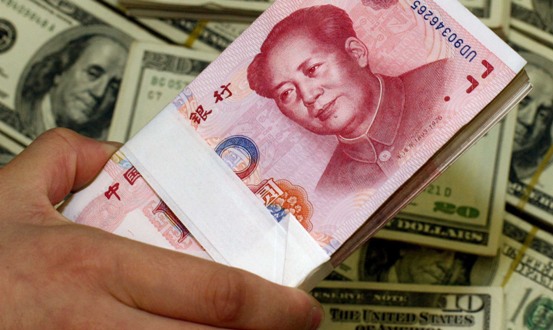
The Ministry of Industry and Trade is keeping a close watch on the impact of China’s sharp yuan devaluation on the exchange rate between the US dollar and the local dong currency and on Vietnam’s foreign trade.
“We are closely following the situation and evaluating its impact to take proper measures,” a leader of the ministry’s Asia-Pacific Market Department told the Daily on August 12 after China’s yuan had dipped for a second day on August 12, hitting a four-year low. China devalued its currency by a total of nearly 4 percent on Tuesday and Wednesday.
Experts said the yuan depreciation would hit two-way trade between Vietnam and China as Vietnam has had a big trade deficit with China over the years and local firms have relied heavily on imports from the northern neighbour.
Vietnam exported $13.2 billion worth of products to China and imported goods worth $36.9 billion from the neighbouring nation in 2013. The respective figures were $19.9 billion and $43.7 billion last year, hence the trade deficit of $23.8 billion.
According to the ministry’s industrial and commercial information centre, Vietnam ran a trade deficit of $16.5 billion with China in the first half of this year and imports from that country in the period soared nearly 24 percent year-on-year.
Steel, machines and equipment, phones and phone accessories, computers, and textile materials are among the major items Vietnam imports from China with annual spending on each product amounting to more than $1 billion.
Experts predicted that local apparel and steel producers would order more materials from China for short-term deliveries to enjoy lower prices due to the yuan devaluation.
The reason is that the yuan weakened by nearly 4 percent against the US dollar while the State Bank of Vietnam on August 12 decided to widen the dong/dollar trading band from 1 percent to 2 percent on either side, effectively devaluing the local currency by 1 percent against the dollar.
China has stepped up steel exports as shown by figures of the Chinese customs. Accordingly, China’s exports in July fell 8.3 percent compared to the year-earlier period but steel shipments went up 9 percent year-on-year and 21 percent month-on-month. This meant China had increased steel exports to ease an oversupply on the domestic market.
Truong Van Phuoc, vice chair of the National Financial Supervisory Commission of Vietnam, warned of more Chinese goods flooding the local market and urged relevant authorities to find ways to deal with this possibility.
Phuoc estimated this year’s trade deficit at $5-7 billion, saying this would not be a big problem as incoming remittances were projected at $12-14 billion.
Phuoc said more time would be needed to see what China would do with its currency in the near future.
Concerns of local firms
Local seafood and farm produce firms whose major export markets include China have felt the pinch of the yuan’s weakening.
Truong Dinh Hoe, general secretary of the Vietnam Association of Seafood Exporters and Producers (VASEP), told the Daily that the yuan fall would impact have on Vietnamese exports to the Chinese market.
Prices of Vietnamese seafood exported to China would be higher if local exporters wanted to settle payments in the US dollar, Hoe said.
“China’s yuan devaluation is aimed to improve the competitiveness of its export products including those similar to Vietnam’s products like tilapia fish and shrimp,” Hoe said.
Figures of VASEP showed shirmp exports in the year to mid-July had dropped over 28 percent year-on-year to $1.4 billion due to sharp declines of revenues from major export markets like the United States (down 50 percent), China (28 percent), Japan (19 percent), Korea (17 percent) and the European Union (14 percent).
VASEP forecast outbound sales of shrimp this year could tumble by $700 million from $3.9 billion last year.
However, he said it was too premature to assess the impact of the weaker yuan on Vietnamese exports to the northern market.
Rice sold to China has accounted for 30-40 percent of Vietnam’s total rice exports in recent years, according to Lam Anh Tuan, director of Thinh Phat Co. Ltd in the Mekong Delta province of Ben Tre. But he said the export price of this staple food has remained unchanged.
By June 20, member enterprises of the Vietnam Food Association (VFA) had signed contracts to ship 1.65 million tonnes of rice with the volume pending for deliveries estimated at 860,000 tonnes.
Though Dang Phuong Dung, vice chairwoman of the Vietnam Textile and Garment Association, said local apparel firms would have a chance to import materials at lower prices due to the yuan depreciation but said that it would not be good in the long term as 42 percent of the sector’s current material imports came from China.
Dung hailed the State Bank of Vietnam’s move to increase the trading band to 2 percent on either side as it would help local exporters maintain their competitiveness in the face of the yuan slide.
Source: Intellasia
Key words: Trade ministry, monitors, impact of weaker yuan, on exports