

In 2014, Vietnam’s textile and garment sector saw a 16 percent rise in the level of its exports, reaching US$24.5 billion. The country has set an export goal for 2015 of between US$28-28.5 billion.
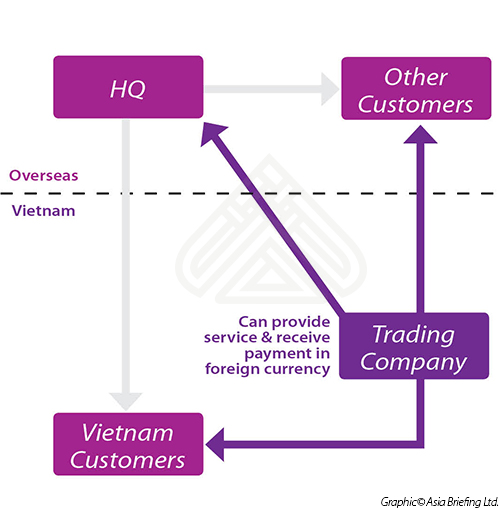
While exporting garments is big business in Vietnam, investors should not ignore the growing opportunities to import products into the country and to take advantage of the growing consumer market there. In order to conduct import, export, and distribution activities in Vietnam, the best investment strategy tends to be to set up a trading company.
Generally, a trading company is inexpensive to establish and can be of great assistance to foreign investors by combining both sourcing and quality control activities with purchasing and export facilities, thus providing more control and quicker reaction times compared to sourcing purely while based overseas.
To set up a trading company (distribution company) without a retailing outlet, or a trading company with its first retailing outlet, investors must apply for an Investment Certificate and submit it to the licensing authority at the provincial level. The provincial licensing authority will then submit the application dossiers to the Ministry of Industry and Trade (MOIT) for approval. Once approved by the MOIT, the provincial licensing authority will grant the Investment Certificate to the investors. If the licensed foreign trading company wants to have two or more retailing outlets, it will be required to complete the procedures for setting up a retail establishment.
Under World Trade Organization (WTO) commitments, around 95 percent of goods can be distributed by businesses that are 100 percent foreign owned. However, for certain types of investment projects, such as those that are deemed to have a significant impact on Vietnam’s national policies, environment, etc., the government must first issue an official investment policy on the project.
The strong predicted growth in the garment sector is a result of a number of free trade agreements that Vietnam is currently negotiating. Chief among these is theTrans-Pacific Partnership– a United States led agreement involving 12 nations. Upon completion, the TPP trade area would comprise a region with US$28 trillion in economic output, making up around 39 percent of the world’s total output. If the TPP is successfully implemented, tariffs will be removed on almost US$2 trillion in goods and services exchanged between the signatory countries.
Vietnam has also signed or is in the final steps of negotiations on FTAs with South Korea, the European Union, and theCustoms Unionof Belarus, Kazakhstan, and Russia.
Source: Vietnam Briefing
Key words: Vietnam, garment, industry, foreign company