
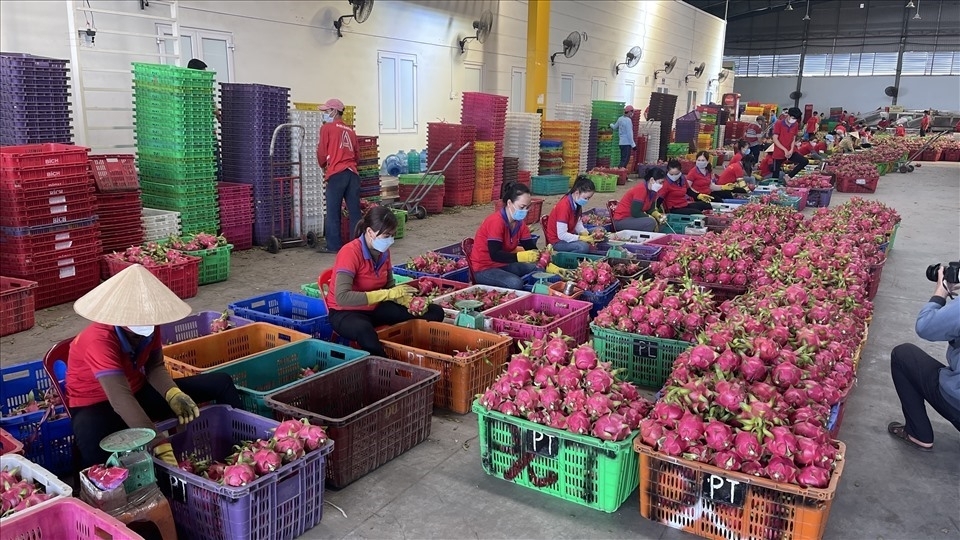
As proposed by the Ministry of Industry and Trade, all agricultural products exported to China must strictly comply with regulations on packaging, packaging, traceability, growing area code, packing establishment code, labeling, as well as other relevant requirements.
Vietnam inherits many favorable conditions to promote the export of agricultural and aquatic products to the Chinese market.
However, in the report sent to the Prime Minister recently on promoting the export of agricultural products through the northern border gate in the form of official trade, the Ministry of Industry and Trade also mentioned a series of difficulties.
Currently, there are many differences in the border trade management policy between Vietnam and China. The central government on the Chinese side assigns the province to operate the border gate, so they are very flexible in closing and opening the border gate, taking the initiative in quality control and checking goods origin.
Except for the pair of international border gates, the main border gate has been officially announced by the two sides, the remaining pairs of additional border gates and openings have not been agreed with China, so the Chinese side has not recognized and considered them border market pairs.
Unprocessed agricultural products (vegetables, tubers and fruits of all kinds officially imported from Vietnam are subject to a value-added tax of about 9% by China).
Therefore, Chinese enterprises that import agricultural products and fruits from Vietnam often choose import form via border residents (because each resident is exempt from tax of 8,000 yuan) and ask Vietnamese traders to bring their goods via a secondary border gate, an opening (a pair of border markets as called by the Chinese) to avoid paying value added tax.
The representative of the Ministry of Industry and Trade added that Vietnam has signed an FTA with China.
The negotiation on import tax has been completed and many agricultural products have enjoyed 0% import tax when exported to China; however, negotiations on quality control are still slow, so there are only nine types of fruit so far that have officially been allowed to be exported to China.
All remaining fruit can only be exported to China in the form of resident exchange, leading to an almost 100% dependence on secondary border gates, openings, i.e. those that are normally closed first in danger of disease occurrence.
Negotiations on quarantine procedures are similarly slow, so the percentage of Vietnamese fruits that have to go through inspection is up to 100% while Thailand's is only 30%, leading to a long clearance time and an increase in congestion, especially during the main harvest season.
Statistics show that among goods congested at the northern border, the number of goods waiting for export in the form of small quotas is much larger than the number of goods waiting for export through the official form through international border gates.
In order to promote the export of goods through the northern border gate in the form of official quotas, the Ministry of Industry and Trade proposes that all agricultural products exported to China must strictly comply with the regulations on labels, packaging, traceability, code of the growing area, code of packing establishment, labeling of goods as well as other relevant requirements.
All agricultural products exported to China must be paid for via bank.
In addition, to encourage the export of agricultural products to open export customs declarations at the local customs office of the growing area to reduce pressure on customs clearance procedures for border local customs offices.
Agricultural products that have been allowed to be exported through official channels to China are given priority to the "green channel" when they pass through the main border gates or international border gates.
In the long term, the Ministry of Industry and Trade proposes to implement solutions to improve Vietnamese agricultural products, thereby diversifying markets and modes of transportation, and gradually reducing dependence on the China market as well as the form of informal export.
Along with that, it is necessary to promote investment in expanding infrastructure, transportation systems at international border gates, main border gates, increase electrification in the implementation of customs clearance, import and export procedures to respond to the transition from small- to official quota.
Besides, researching, connecting to attract investment, promoting the construction of logistics centers (transshipment points) in the area near or close to the Vietnam - China land border. Accordingly, these centers are concentrated areas for preliminary processing of final stages of products and goods, preserving goods (cold storage, dry storage, yard) associated with quarantine and testing to standardize goods quality, ensure disease safety and food safety.
Source: VCN
Keywords: Ministry of Industry and Trade, agricultural products, border gate, product