
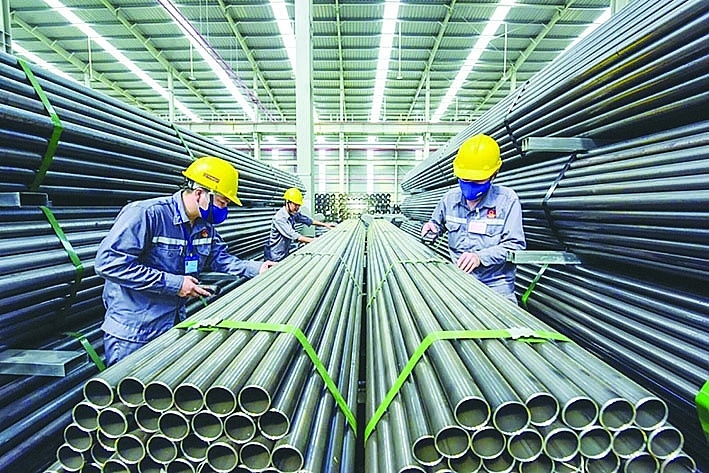
While domestic consumption is facing difficulties, Vietnam's steel exports to the EU are growing strongly. However, in the coming time, if Vietnamese steel enterprises do not respond well to the carbon border adjustment mechanism (CBAM), exports to the EU will be directly affected.
New EU policy tool
For many years, the EU has been Vietnam's fourth most important two-way trading partner after China, the US, and South Korea. Vietnam is the EU's 15th goods trading partner and the EU's most prominent trading partner in ASEAN. According to the Vietnam Steel Association, in the first 6 months of 2023, Vietnam's trade surplus of goods to the EU was estimated at USD 14.5 billion, down 9.8% over the same period last year. However, steel export in the first 6 months of 2023 is estimated at 1.36 million tons, with export turnover reaching about USD 1 billion, an increase of 1.5 times compared to the same period in 2022 and a slight decrease in export value.
From 1 October 2023, the EU's Carbon Border Adjustment Mechanism (CBAM) - a new EU policy instrument that allows additional taxes on high-emissions imports - began to be implemented for a transition period. In which iron and steel are the first applied commodity groups along with cement, aluminum, fertilizer, hydrogen, and electricity.
The phase of full implementation of the carbon border adjustment mechanism is expected to start from the end of 2026 when importers of covered goods will have to purchase a certificate of the carbon border adjustment mechanism (CBAM) and must declare the quantity of goods as well as the emissions associated with those imported into the EU.
Mr. Nghiem Xuan Da - Chairman of the Vietnam Steel Association said that in the past time, the Vietnamese Government has actively participated in international cooperation activities in response to climate change and made efforts to implement activities aimed at reducing greenhouse gas emissions. Vietnam also identifies the carbon pricing tool to be applied in the near future as the domestic carbon market through the application of greenhouse gas emission quotas for large emitters.
Green production is an inevitable trend
Ms. Le Huyen Nga, Department of Multilateral Trade Policy, Ministry of Industry and Trade informed about the concepts and dangerous levels and consequences of carbon leakage that the world is facing. Therefore, the carbon border adjustment mechanism is a very necessary mechanism, especially for the steel industry because the steel industry is considered to be an industry with many risks to the environment.
In the long term, green production is a common and inevitable trend of the world, not only the EU but other markets will also apply strict policies on environmental protection, health protection... with imported products. Vietnamese steel enterprises must have orientations to innovate production and processes to keep pace with the trend of stable and sustainable development in the future. The EU's Carbon Border Adjustment Mechanism (CBAM) is one of the necessary and sufficient conditions.
According to the leader of Posco Korea, CBAM greatly affects the steel industry. Accordingly, in response to this regulation, Posco Korea is aiming to be carbon neutral by 2050. To accomplish this goal, the roadmap from now to 2040, Posco will reduce carbon emissions by 50%. This is not a simple challenge. To do this, the leader of Posco Korea said that he is exploiting a new advanced technique that does not use carbon to produce steel, but replaces it with hydrogen.
The leader of this group also said that he understood the roadmap to apply the CBAM mechanism, but there were still some problems with the unclear mechanism. “I myself went to Europe five times last year to talk about this issue”. The EU also said that there are still some issues related to the mechanism. However, they are still resolute with the roadmap, steel enterprises, including Vietnam, must comply with the reporting regime. This will be a trade barrier for the steel industry, requiring businesses in the steel industry to have a common voice to go further and respond to the CBMA mechanism
Mr. Nghiem Xuan Da said that Vietnam's steel industry and steel enterprises continue to coordinate with ministries, international organizations, and industry associations to take action to meet CBAM. At the same time, conducting impact assessment studies on Vietnam for steel industries with a high risk of carbon leakage according to the EU list. Solutions and implementation roadmap must be researched to balance the gradual reduction of carbon emissions for all manufacturing industries, ensuring competitiveness with the world.
Source: VCN
Keywords: steel industry, carbon