
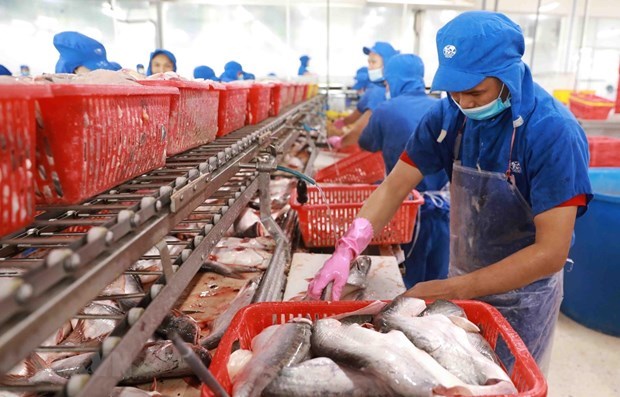
Every year, seafood enterprises have to spend hundreds of billions of VND to carry out quarantine for 100% of frozen processed seafood products imported for export processing in order to avoid domestic disease transmission.
100% of imported goods are subject to quarantine
According to statistics from the General Department of Vietnam Customs, the number of imported seafood product lines (chapters 16 and 3 - except for heading 03.01 for live aquatic products) subject to specialized inspection following Circular 11/2021/TT-BNPTNT remains the same as Circular 15/2018/TT-BNNPTNT (391 lines) of the Ministry of Agriculture and Rural Development.
According to the leader of the Vietnam Association of Seafood Exporters and Producers (VASEP), the Ministry of Agriculture and Rural Development has moved some products to the list of "Only Food Safety inspection" in Circular 11/2021/TT-BNNPTNT with a very small import rate, most used for domestic consumption are not substantial in risk management.
In Circular 11/2021, there are 83 product lines that have been changed to the list of "only food safety inspection" which are mainly smoked, dried, pickled products, sausages, shark fins, fish roe, etc.
Those products are mainly imported for domestic consumption, the value of import turnover of this group of product lines is insignificant. The actual import data of this product group accounted for only 1.51% in the first nine months of 2021.
The remaining 308 product lines, accounting for more than 98% of the import value, are subject to quarantine or food safety inspection. However, they follow the mechanism and method specified in Circular 26/2016/TT-BNNPTNT and Circular No. 36/2018/TT-BNNPTNT of the Ministry of Agriculture and Rural Development, that is 100% of containers imported to Vietnam must be quarantined. This group of goods is mainly frozen processed goods, mostly food (for human consumption) and 70-80% of the total annual import value of those goods was not for domestic consumption but used as a source of raw materials for export processing.
Thus, according to VASEP, is the continuation of "100% quarantine" for frozen processed seafood products imported for export processing (not for domestic use) in order to protect and avoid disease transmission in the future necessary? Meanwhile, the results of "quarantine" in the past years did not detect violations or the detection rate was extremely low.
Spending hundreds of billions of VND in quarantine
According to VASEP, the current problem is that even though seafood products are imported for export production and processing (accounting for 70-80%, not for domestic consumption) or for domestic consumption. Even though there is still one type of product, one source of origin, and one importer for many years, 100% of the containers imported must still be inspected and signed by the Department of Animal Health and be transferred to the Customs authority to carry out clearance procedures
Thus, the risk-based management was not applied, making the list of goods subject to inspection very small and 100% of imported containers subject to inspection. The main reason here is that circulars have put most of the import inspection activities under quarantine.
Even in the past 10 years, the criteria of quarantine in the list of imported aquatic products subject to quarantine have been expanded without any change in the legal basis or risk reporting, international practice or disease information. Thus, besides increasing the list of aquatic products subject to quarantine, the current circulars on aquatic quarantine also do not distinguish between the criteria of "epidemic safety" and "food safety" when the product is processed food for human consumption.
According to VASEP, the above regulations have created an additional burden of time and compliance costs for businesses and society.
According to regulations, each shipment must have an import quarantine certificate issued by the Department of Animal Health in order to carry out clearance procedures. Thus, each container will have to wait for quarantine procedures for at least two working days (for shipments that only have to check documents) to five working days (for shipments that must take samples for testing). It does not include waiting time if the working time is at weekends or waiting time to be quarantined by the staff of the Department of Animal Health.
According to VASEP's statistics, in the first nine months of 2021, with the number of imported seafood in over 50,500 shipments and only the minimum time required for quarantine procedures is two days per shipment, it is estimated that the time required for enterprises to carry out quarantine procedures is nearly 135,000 days per year and it is estimated that the minimum cost for storage alone has reached more than VND224 billion.
Source: VCN
Keyowords: imported seafood, export processing, quarantine, Department of Animal Health, food safety inspection