

Regarding basic solutions to remove difficulties and congestion of goods at the northern border gates, the Ministry of Industry and Trade recommends reducing spontaneous production and increasing production according to market signals and orders.
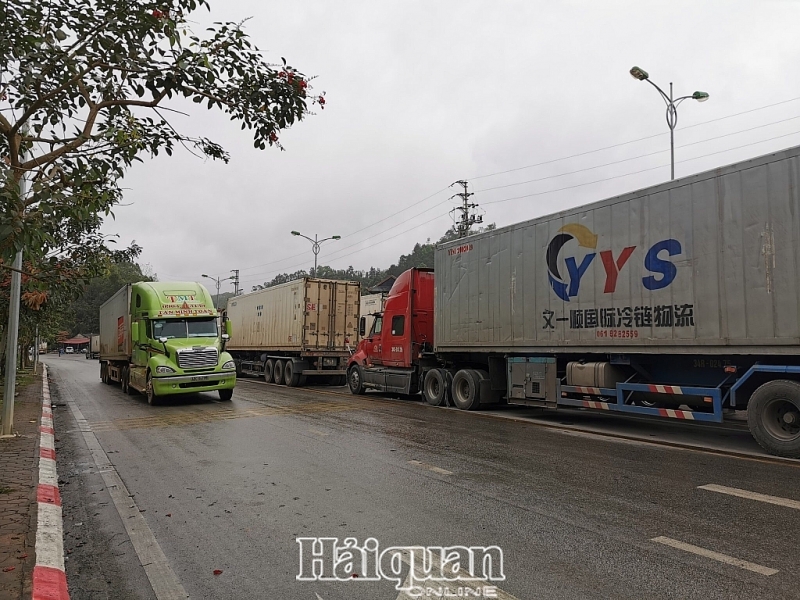
According to the report of the Department of Industry and Trade of the northern border provinces, the total number of vehicles waiting for export at the Vietnam - China border gates as of January 3, 2022 is 4,250.
The most congested site is in Lang Son. The total number of vehicles at the three border gates of Huu Nghi, Tan Thanh and Chi Ma as of January 3, 2022 was 2,558, a decrease of 1,771 compared to the morning of December 24, 2021.
The Ministry of Industry and Trade said that the direct and main cause of the congestion is the Chinese side completely stopping customs clearance at nearly all border gates, including important ones, the volume of commercial exports is very high such as Kim Thanh (Lao Cai), Tan Thanh (Lang Son) and Mong Cai (Quang Ninh).
With border gates still temporarily open (such as Huu Nghi, Chi Ma, Hoanh Mo), the delivery and receipt process is strictly controlled avoiding the risk of disease, leading to large-scale congestion.
In the immediate future, the Ministry of Industry and Trade recommends that ministries and branches coordinate with local People's Committees to call and advise traders to regulate the delivery of goods to the northern border, especially at border gates where there is a phenomenon of congestion, including cases where Chinese customers have paid for the goods.
"If the vehicles continue to go to the border gate, the Ministry of Transport is requested to study and regulate the number of vehicles entering and waiting in the following localities. Because from now to the Lunar New Year, only existing vehicles can be handled, especially when Chinese workers can take up to 21 days off before Tet to complete the isolation period," the Ministry of Industry and Trade stated.
In case the Chinese customer has paid for the goods and requests to bring the goods to the border, the Ministry of Industry and Trade recommends that traders discuss with Chinese customers to deliver the goods through the main border gates and international border gates. Other provinces (such as Cao Bang) in order to reduce congestion in Lang Son, Quang Ninh or switch to other modes of transport (such as railways and seaways, in which seafood exporters are currently doing very well).
Regarding radical solutions, the Ministry of Industry and Trade said that it is necessary to diversify markets, diversify modes of transportation, and gradually reduce dependence on the Chinese market as well as on the form of informal export.
The four most important solutions assessed by the Ministry of Industry and Trade include:
First, reducing spontaneous production, increasing production according to market signals and orders.
Second, improving and strictly controlling the quality of agricultural and aquatic products, meeting the expectations of domestic and foreign consumers.
Third, disseminating and guiding farmers on methods of production, farming, packaging, processing, etc. to meet the standards of each importing country and region.
Fourth, promoting the registration of growing areas as well as traceability to facilitate official export and reduce the time for customs clearance of goods.
Focusing on in-depth analysis of agricultural product congestion at northern border gates, talking to Customs News, Mr. Tran Thanh Hai, Deputy Director of the Import-Export Department (Ministry of Industry and Trade) said, in terms of long-term solutions, it is very necessary to have large and strong enterprises that can order farmers to produce, and then sell products.
These businesses will guide farmers to produce according to new processes, in accordance with customer needs, apply traceability, use geographical indications, and build brands.
Those businesses will have the capacity to sign contracts with distribution businesses across the border, using large-scale transportation methods such as sea and rail to optimize costs. "Thus, farmers do not have to worry about production and sales at the same time, businesses can also put fruit export activities in order," Mr. Hai said.
The leader of the Import-Export Department said: "It is urgent to step up negotiations with China to expand the list of officially imported fruits.”
The airports, seaports and border gates are very important infrastructure in the international logistics chain, while border gates are often located in mountainous terrain, with limited ground space, according to Mr. Hai, besides investing in expanding border gate infrastructure, it is necessary to reduce the load on the border gate by building a logistics center system to move back inland.
These logistics centers not only have cold storage to preserve and preliminarily process agricultural products before export, but also a place for goods inspection and clearance. Goods after customs clearance only need to be sealed, brought to the border gate for export across the border, reducing the time and process of customs clearance at the border gate.
"With such synchronous solutions, many agricultural products will be officially exported," Mr. Hai said.
Source: VCN
Keywords: remove congestion, Chinese side, cargo clearance, reducing spontaneous production, northern border gates