
While many developed countries have been struggling with the pandemic, Vietnam has maintained a trade surplus of nearly $1.29 billion in the first two months of 2021. However, a large portion of this relies on foreign-invested enterprises, a fact that government officials and economists want to balance with their domestic counterparts.
Samsung Vietnam can look back at positive results from last year. Talking to VIR, a representative of Samsung Vietnam confirmed that the impact of the “pent-up demand” by the pandemic has been helping the company to gradually recover.
The total export turnover of Samsung Vietnam in 2020 reached about $57 billion, an important milestone for the company as one of its most important branches, Samsung Electronics, aims to become the largest chip manufacturer in the industry, targeting a value of around $400 billion.
Samsung Electronics together with many other transnational corporations has been increasing investment in Vietnam for many years, mostly driven by low taxes, affordable labour, and good land incentives.
Foreign-invested enterprises (FIE) are dominating Vietnam’s exports, accounting for 69 per cent of the country’s total export turnover, according to the Ministry of Industry and Trade (MoIT). This has contributed to bringing Vietnam into the group of the few countries still achieving positive economic growth during the first year of the pandemic, as well as maintaining a trade surplus of nearly $1.29 billion in the first two months of 2021.
Electronics take over
Vietnam’s merchandise exports have shifted from relying on crude oil to focusing on electronics. However, the fact that this sector lies mainly in the hands of FIEs has a large impact on the country’s export growth.
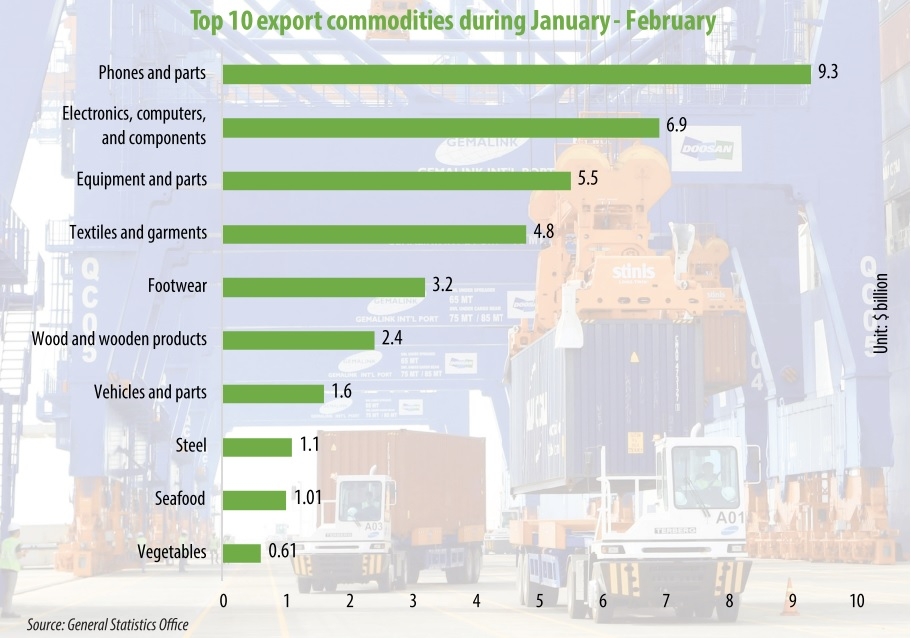
While in 2010, exports of phones and spare parts thereof only accounted for 3.2 per cent of the total export turnover, by 2020, this sector ranked first among the six commodity groups with a turnover of over $10 billion each, reaching a preliminary turnover of over $51.2 billion alone.
In the first two months of 2021, the export value of this group was already estimated at $9.3 billion, accounting for 19.2 per cent of the total export turnover, up 22.8 per cent over the same period last year.
Vietnam has the right to rejoice over its outstanding pandemic record. But the country’s export surplus could be very precarious if, in the short term, this surplus comes from the sale of facemasks and protective equipment to Europe and North America.
Data from the MoIT shows that due to the traditional Lunar New Year holiday, exports in February decreased by 29.9 over the previous month and by 4.7 per cent compared to the same period in 2020. Meanwhile, the import turnover of commodities in February also reduced by 21.4 per cent over the previous month, though it increased by 10.5 per cent over the same period last year.
Dr. Pham Tat Thang, an expert from the MoIT’s Institute of Industrial and Trade Policy and Strategy has taken into account the possibility that reducing imports might affect future production because the means of production account for 90 per cent of Vietnam’s imports while only the remainder consists of consumer goods.
“Vietnam has an export surplus – an important factor that helps increase foreign exchange reserves in the face of global economic fluctuations and the pandemic – but the decline in imports proves that the country’s production remains difficult,” Thang commented.
The lack of orders and the sluggish recovery of supply chains are the two main reasons for reduced imports.
Currently, many businesses are using raw materials stored in the country for production to reduce import costs, while container prices rise.
Will Mackereth, supply chain director of Nestlé Vietnam, told VIR, “The worldwide ocean freight and container availability has been hugely disrupted by the changing dynamics of trade through the pandemic. Costs have gone up enormously, often four or five times, sometimes even as much as ten times.”
Despite these challenges, Nestlé Vietnam has been among the winning FIEs active in Vietnam. “Our export performance last year was excellent, and we have carried this momentum into early 2021. We continue to prioritise our export activities while ensuring the best service and quality products to our customers around the world,” Mackereth said.
Surpassing FIEs
The driving force in the production and export of industrial products has so far come from FIEs.
This is the “consequence of weak links between FIEs and domestic counterparts in the supply chain,” Tran Tuan Anh, Minister of Industry and Trade, explained in January, adding that “this also reflects the low productivity growth and the weak competitiveness of domestic players”.
The processing and manufacturing industry continued to play a leading role in the growth of Vietnam’s economy last year, with an increase of 5.82 per cent. According to Minister Tuan Anh, the country’s large- and medium-sized enterprises account for a very small proportion of just about 2 per cent and have not led small- and micro-sized enterprises in linking regional and global value chains.
Most domestic businesses are small- and micro-sized ones, accounting for about 98 per cent of all businesses operating in the economy. They commonly have a low level of technology, limited financial capacity, and scarce high-quality human resources.
It is undeniable that Vietnam’s policies to attract foreign direct investment (FDI) have brought about good results for the economy. Data from the Ministry of Planning and Investment shows that FIEs contribute about 20 per cent to national GDP and is an important additional capital source for investment and development capital with a proportion of about 23.7 per cent in total social investment.
Almost 60 per cent of the total FDI is concentrated in the manufacturing sector, creating over half of the country’s industrial production value and nearly four million direct and five million related jobs.
Concerns about exports being dependent on FIEs seem less relevant as more foreign corporations are now investing in high-tech, research, and development – all areas that are not the strong points of domestic manufacturers.
Meanwhile, the government encourages domestic suppliers to participate in regional and global value chains.
Prof. Dr. Nguyen Mai, chairman of the Vietnam Association of Foreign-Invested Enterprises, said that the share of the domestic suppliers is increasing year by year, from 28.3 per cent in 2018 to over 30 per cent last year.
“The problem now is to increase the domestic suppliers’ export turnover at a much higher pace than FIEs’,” Mai said.
Source: VIR
Key words: Samsung Vietnam, foreign invested enterprises, FIE