
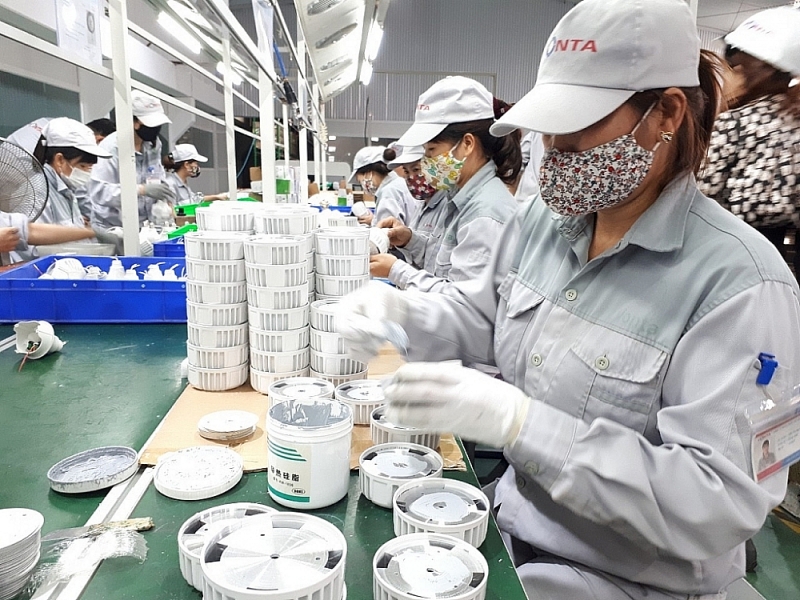
One of the emerging challenges for Vietnam's industrial development is that the driving force in Vietnam's production and export of industrial products is currently driven by the FDI sector, accounting for approximately 70% of the country's total export turnover.
According to the latest information from the General Statistics Office (Ministry of Planning and Investment), early this year, industrial production continued to flourish. The number of working days in January 2021 was higher than that of the previous year, so the industrial production index in January 2021 was estimated to increase by 22.2% compared to January 2020, of which the processing and manufacturing sectors increased by 27.2%.
The index of industrial production (IIP) in January 2021 decreased by 3.2% from the previous month and increased by 22.2% from the same period last year.
In which, the manufacturing sector increased by 27.2%, contributing 21.6 percentage points to the general growth; electricity production and distribution rose 16.3%, contributing 1.5 percentage points; water supply, wastewater management and treatment increased 8.4%, contributing 0.1 percentage points; the mining industry alone decreased by 6.2%, down 1 percentage point.
Looking back on the process of industrial production development in Vietnam, Minister of Industry and Trade Tran Tuan Anh said that, up to now, Vietnam has become one of the countries with industries belonging to the group of countries with a high average global competitiveness.
“Up to now, Vietnam has formed a number of key industries of the economy such as: oil and gas exploitation and processing; electronics, telecommunications, information technology; metallurgy, iron and steel; textiles and garments, leather and footwear, creating an important foundation for long-term growth, as well as promoting the modernization and industrialization of the country,” said Minister Tran Tuan Anh.
However, the leader of the Industry and Trade sector also emphasized five major challenges and difficulties posed in the industrial development process of Vietnam.
First, industrial production of Vietnam was still focusing mainly on production activities in the last stage, bringing low added value; there was also an unsynchronized development, lack of connection among the links of the internal sector, among industries, leading to unsustainable development.
Second, the driving force in the production and export of Vietnamese industrial products was still mainly driven by the FDI sector, accounting for approximately 70% of the country's total export turnover.
This was a consequence of the weak linkage between FDI enterprises and domestic enterprises in the supply chain, indicating the limited competitiveness of domestic enterprises to participate in global value chains.
In essence, this was a sign of low productivity growth and weak competitiveness of the domestic economic sector. Most of the domestic enterprises were small and micro (accounting for about 98% of enterprises operating in the economy), had a low technology level, limited financial capacity, and were unlikely to accumulate and invest in tech innovation, with limited high-quality human resources.
“This has resulted in low competitiveness and limited ability to participate in the regional and global value chains. Vietnam's large and medium-sized enterprises account for a very small proportion (about 2%), do not really play a leading role for micro and small enterprises in linking regional and global value chains," Minister Tran Tuan Anh said.
Next, the head of Industry and Trade said that the sustainability in the production and export development of Vietnam still had many potential risks, especially in the context of the increasingly complicated, faster and more unpredictable world.
Extensive integration with a higher open economy was also affected more directly, more quickly and strongly when the world situation changed.
Meanwhile, Vietnam would not only be affected by the demand side (output market), but also from the supply side (the supply channel of raw materials for domestic production). The impact of the Covid-19 pandemic in 2020 was a typical example of this multi-dimensional impact on the Vietnamese economy when Vietnam was facing both difficulties in the output market for exports and broken supply for domestic production.
The fourth challenge, noted by Minister Tran Tuan Anh, is that Vietnam's trade costs were still high – higher than the average of ASEAN logistics costs and costs of compliance with regulations in border and post-clearance. This was one of the reasons that directly affected the cost of products and affected the competitiveness of Vietnam's exported products.
Finally, the organization and distribution of the space for industrial development had not exploited the competitive advantages of regions; had not yet formed many specialized industrial clusters to link chain development and enhance the participation of Vietnamese enterprises in the global supply chain.
Source: VCN
Key words: index of industrial production, FDI sector, import-export activities, supply chains, small and micro enterprises