

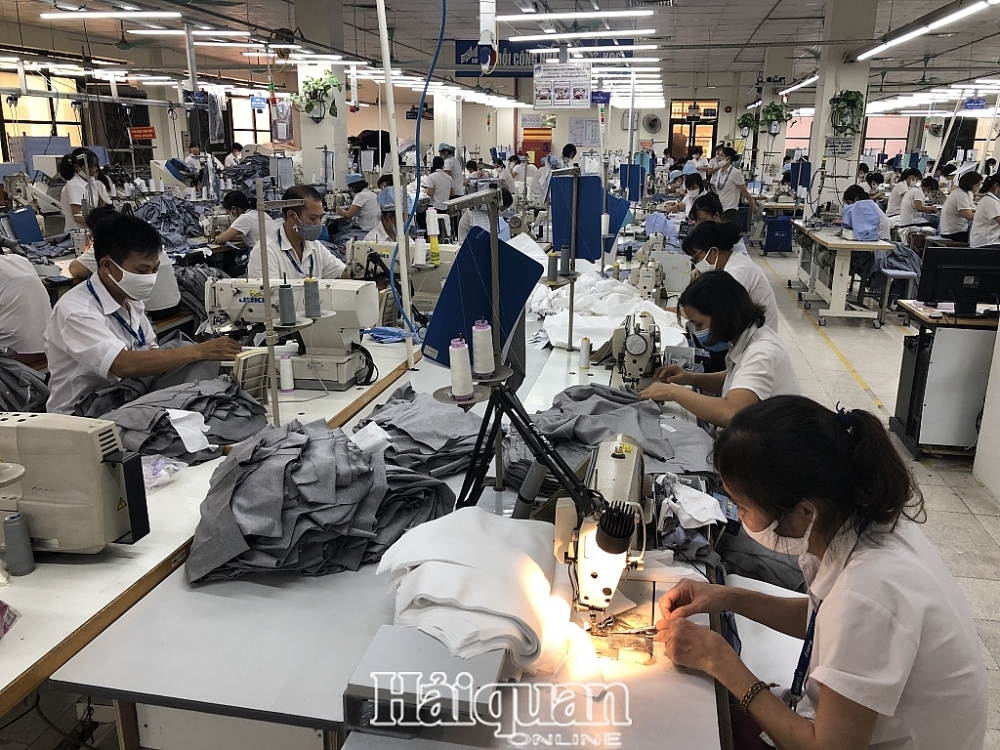
On January 19, the Vietnam Economic Institute (Vietnam Academy of Social Sciences) held a seminar on "Vietnam's Economy in 2020 - Promoting growth based on innovation".
According to many experts, the economic shock of Covid-19 was much heavier than the two shocks of the 1997 Asian financial and monetary crisis and the 2008 global financial crisis.
The two shocks above caused the lowest growth rate of 4.77% in 1999 and 5.4% in 2009. This economic growth rate was still higher than that of 2020 (2.91%). However, the Covid-19 shock may be temporary and will not last as long as the two financial shocks of 1997 and 2008.
Speaking at the seminar, Bui Nhat Quang, President of Vietnam Academy of Social Sciences, said that in2020, the Covid-19 pandemic had different impacts by sectors. Sectors with large face-to-face contact - except for supplies and equipment for medical prevention and treatment - experienced a sharp decline in GDP growth and the industries most affected were services, especially tourism, transportation, and restaurants.
Meanwhile, non-contact economic sectors (14 industries, most of the digital economic sectors) were most positively affected, especially distance education, electronic payments and industries with the input of oil/gas products. These multidimensional impacts promoted restructuring as well as cutting business costs and changing corporate governance within industries.
According to the Vietnam Economic Institute, the impact on the finance-banking sector was multidimensional and positive, especially for the stock market as transactions and the number of investors increased. However, the limitation in Vietnam is the stock price boom, securities company profit does not lead to quantity/value of new IPO or equitisation. This is a shortcoming and difference of Vietnam. Vietnamese insurance companies also increased their profits due to few deaths while fear of Covid-19 increased. Although the banks' profit margins decreased, they still increased their profits; however, the risk of bad debt increased. All three types of financial institutions benefitted from the sharp rise in equity prices.
For workers, the impact by sector of activity and skill was different. Accordingly, the Covid-19 pandemic affected workers working in almost all sectors, in which some industries with the largest affected labour rates are arts, entertainment, accommodation and food services (81.7%), transportation, warehousing, administrative activities and support services.
However, higher is the professional and technical level, the lower is the unemployment and underemployment rate. The strongest labour lost is in services related to international tourism, including air transport and tourism industries; accommodation service industry down by 29.9% and industries of sports and entertainment.
The Covid-19 pandemic also brought the economy into greater uncertainty. Public debt and foreign debt increase; direct Government debt/revenue obligations and national/export foreign debt service obligations have also increased; non-performing loans in the banking system also tended to increase.
According to Pham Sy An, Head of Department of Macroeconomics and Economic Institution, Vietnam Institute of Economics, Covid-19 reduced many indicators reflecting the quality of growth such as ICOR, up from 6, 08 (in 2019) to 14.28 by 2020 and TFP's contribution to GDP has decreased from 47.71% (in 2019) to 37.48% in 2020.
In addition, labour productivity growth also decreased from 6.28% in 2019 to 5.4% in 2020. However, these indicators are likely to improve as the Covid-19 pandemic ends and Vietnam’s economic growth will recover in 2021 (as forecasted by international organisations as well as by the Vietnam Economic Institute).
Source: VCN
Key words: import, export, goods, impact, Covid-19 pandemic